

As professional commercial painting contractors, we’re often asked whether brushing or spray painting is the better choice for a project. The truth is, there’s no one-size-fits-all answer—but there is always a best-fit solution based on the building type, surface condition, schedule, and business operations.
In most cases, it’s our job to assess the space, understand your priorities, and determine which method—brushing, spraying, or a combination of both—will deliver the best results with minimal disruption. Each technique has its advantages. Brush and roller application provides control and flexibility, especially in occupied or detail-heavy areas. Spray painting offers speed and a smooth, high-end finish, making it ideal for large, open surfaces.
In this article, we’ll break down the key differences between the two methods as they apply to commercial environments—helping you understand how we make those decisions, and what to expect from each approach.
- Why painting method matters in commercial projects
- Understanding the two main painting methods
- Brush paint application: traditional brush and roller techniques
- Spray paint application: modern spray techniques
- Brushing vs. spray painting commercial building walls
- Which method is better? A detailed comparison table
- When brushing makes more sense
- When spraying is the smarter choice
- Hybrid approach: using both methods effectively
- Which technique is right for your business?
- Best painting method for commercial interiors
- Best painting method for commercial exteriors
- Choose commercial painting experts who use the right method for the job
- Frequently asked questions about commercial painting methods
Why painting method matters in commercial projects
Choosing the right painting method is more than just a technical decision—it directly impacts your project’s timeline, budget, and overall outcome. In commercial settings, where efficiency, safety, and visual consistency are critical, selecting between brush painting and spray painting can determine whether a job meets deadlines or causes costly delays.
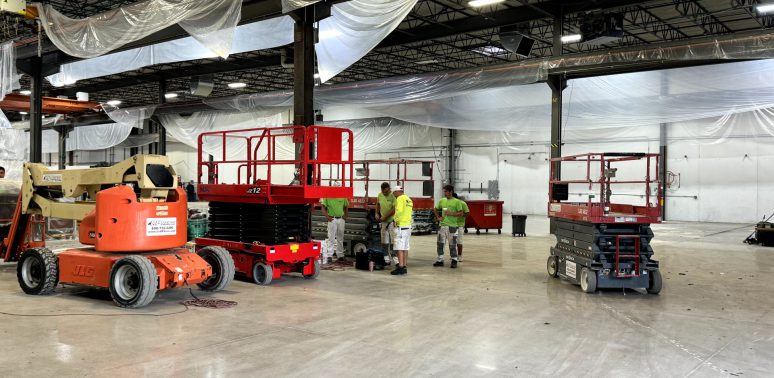
Every building type—whether it’s an office, warehouse, medical facility, or retail space—comes with unique surfaces, access limitations, and operational demands. The right application technique must align with these factors to deliver lasting results while minimizing disruption to business activities.
From labor efficiency to finish quality and even regulatory compliance, understanding the pros and cons of each method helps property managers and contractors make more informed, cost-effective decisions.
Understanding the two main painting methods
Commercial painting professionals generally rely on two core methods to apply paint: brushing (or rolling) and spray painting. Each has its place, depending on project scale, surface type, and required finish.
- Brush and roller painting is the traditional approach. It offers excellent control and precision, especially in tight spaces or for detail work. It’s commonly used in interior offices, trim work, or when minimal disruption is required.
- Spray painting, particularly with airless sprayers, is the modern go-to method for large surfaces and high-volume projects. It applies paint quickly and evenly, making it ideal for commercial ceilings, exteriors, warehouses, and new construction.
While both methods are effective, they differ significantly in speed, finish quality, prep time, material usage, and equipment needs. The following sections will break down these differences in detail to help you choose the right approach for your business environment.
Brush paint application: traditional brush and roller techniques
Brushing and rolling remain foundational techniques in commercial painting—especially when precision and control are required. This method involves applying paint manually using brushes for edges, corners, and trim, and rollers for broader surfaces.
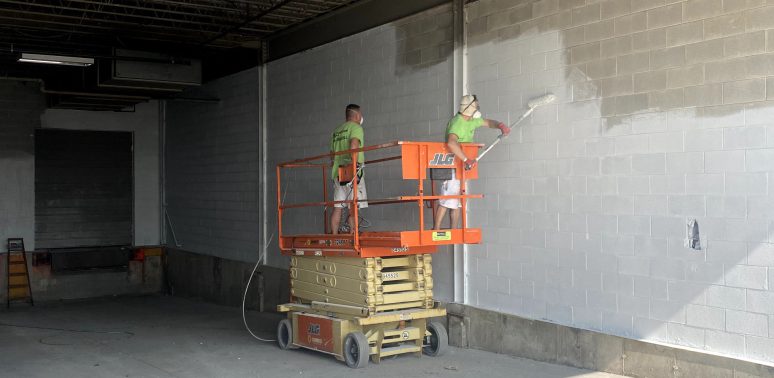
It’s most often used in interior spaces such as offices, stairwells, healthcare facilities, and occupied environments where masking and ventilation for spray equipment would be disruptive.
Brush painting is slower compared to spraying, but it allows painters to work around tight areas, apply thicker coats with more accuracy, and avoid overspray. It also requires minimal setup, making it ideal for smaller-scale or segmented projects where speed is less important than detail and cleanliness.
Pros & cons of brush painting
Before deciding if brush painting is the right fit for your commercial project, it’s important to weigh its strengths and limitations. While it offers excellent coverage and control, it also comes with increased labor time and a less uniform finish.
Brush painting pros:
- Precision and control: Brushing allows for exceptional accuracy when painting around electrical outlets, HVAC vents, light fixtures, and trim. It’s ideal for cutting in clean lines and handling architectural details where overspray would be problematic.
- Minimal overspray: Because paint is applied directly, there’s no risk of atomized particles drifting onto floors, furniture, or adjacent surfaces. This significantly reduces the need for masking and protects sensitive equipment or tenant belongings.
- Better for small or segmented jobs: Brush and roller painting is perfect for projects that can’t be completed all at once. It allows crews to work in phases, avoid excessive setup or shutdown time, and resume painting with minimal disruption—ideal for multi-room facilities, stairwells, or tenant-improvement work.
- Lower equipment costs: Brushing only requires high-quality brushes, rollers, trays, and extension poles. There’s no need for costly sprayers, compressors, or specialized tips. This makes it more affordable for smaller commercial crews or quick-turn projects.
- Safer for occupied buildings: Brush painting doesn’t aerosolize paint into the air, meaning no fumes are circulated through HVAC systems or shared indoor air. It also avoids the high-pitched noise of spray machines, making it more suitable for offices, medical clinics, or schools in use during painting.
- Less prep time for detail areas: In rooms with many interruptions—windows, built-ins, signage—brushing requires less taping and masking compared to spraying around all those elements.
Brush painting cons:
- Slower application speed: Brushing and rolling are labor-intensive, particularly on large, uninterrupted walls or ceilings. A task that might take one hour with a sprayer could take three or more with a brush, increasing project duration.
- Inconsistent texture: Manual techniques can leave behind roller stipple or brush marks, especially with thicker coatings or low-sheen paints. While some texture may be acceptable, high-end clients often prefer the uniformity of sprayed finishes.
- Higher labor costs: Because brush painting takes longer, labor costs rise accordingly. On large-scale commercial jobs, this may push the overall budget beyond that of spraying—even when equipment costs are lower.
- Physical strain on workers: Repetitive motion—especially when reaching high walls or ceilings—can be more physically taxing than spraying. This increases fatigue and potential for error on long-duration jobs.
- Limited scalability: For multi-thousand-square-foot facilities, brush work doesn’t scale as efficiently. Coordinating multiple painters across large surfaces risks variations in coverage and appearance.
Spray paint application: modern spray techniques
Spray painting has become the go-to method for large-scale commercial painting projects due to its speed, consistency, and high-end finish quality.
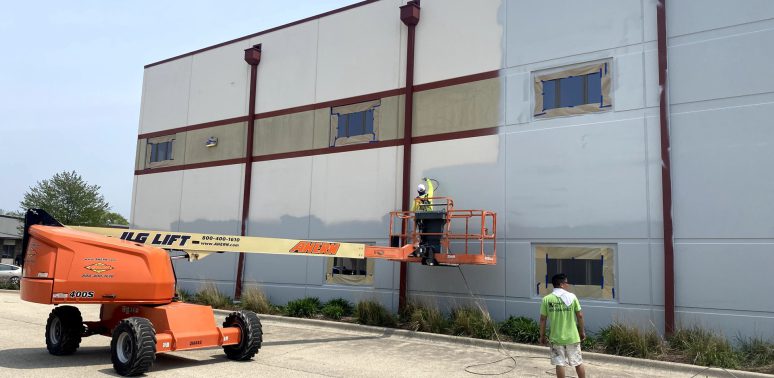
Using pressurized systems—most commonly airless sprayers—paint is atomized into fine particles and applied in an even layer across the surface. This allows for fast coverage of broad areas like warehouse walls, tilt-up concrete panels, metal cladding, and commercial ceilings.
There are several types of commercial spray systems, including airless, HVLP (high-volume, low-pressure), and conventional spray setups. Each has its own strengths depending on the material being applied, the environmental conditions, and the required finish quality.
While spray painting offers numerous advantages, it also demands more setup, masking, and training than traditional methods. It’s best suited for projects where disruption can be minimized and where a sleek, uniform appearance is required. In new construction, unoccupied buildings, or exterior repainting, spray techniques offer unmatched efficiency.
Pros & cons of spray painting
Spray painting is a powerful technique for covering large commercial surfaces quickly and evenly—but it comes with trade-offs. From setup to cleanup, this method demands more planning, control, and technical skill. Understanding its strengths and limitations helps ensure it’s used where it delivers the most value.
Spray painting pros:
- High-speed application: Spray painting significantly reduces the time needed to cover large surface areas. This makes it ideal for commercial warehouses, parking garages, exterior walls, and other high-square-footage projects. What might take a team several days to brush or roll can often be sprayed in a single shift.
- Smooth, uniform finish: Sprayers atomize paint into fine droplets, resulting in a sleek, consistent surface with no visible brush strokes or roller texture. This makes spraying the preferred method for achieving modern, clean aesthetics—especially for retail, hospitality, or client-facing environments.
- Ideal for textured or irregular surfaces: Spray equipment allows paint to reach into grooves, ridges, and surface imperfections that brushes might miss or struggle to fill. This is especially useful on surfaces like stucco, cinder block, corrugated metal, or heavily textured drywall.
- Efficient on ceilings and overhead areas: Spraying enables faster and less physically taxing application when working above shoulder height. It’s particularly useful in commercial ceilings, overhangs, and exposed ductwork where rolling would require ladders, scaffolding, or awkward angles.
- Scalable for large commercial projects: With multiple spray rigs and trained operators, large teams can cover vast square footage quickly. This makes spraying a smart choice for new construction, repaints of large facilities, or night-shift work where time is extremely limited.
- Cleaner finish for fast-turn projects: When appearance matters but time is short—such as in tenant turnover or hotel refreshes—spraying delivers professional results quickly with fewer passes.
Spray painting cons:
- Extensive masking and prep work: Spray painting requires all adjacent surfaces to be masked or shielded from overspray, including floors, fixtures, windows, and HVAC registers. In complex environments, masking alone can take as much time as the painting itself.
- Increased paint waste and material costs: Atomization results in paint loss through overspray and rebound, especially in windy or poorly ventilated conditions. Spraying can use 20–50% more paint than brushing, depending on surface and technique.
- Not suitable for occupied or sensitive environments: Sprayed paint particles linger in the air and can settle on furniture, equipment, or trigger HVAC circulation issues. This makes spraying less appropriate for offices in use, healthcare settings, or commercial kitchens unless special containment is used.
- Higher equipment investment and maintenance: Spray rigs, hoses, tips, and filters require ongoing cleaning, calibration, and replacement. Equipment failure can delay jobs and add unplanned costs, while improper use can cause drips, sags, or uneven layers.
- Requires skilled operators: Spray painting involves a learning curve. Without experience, painters may apply coats too thinly or too heavily, leading to surface defects or uneven coverage. This risk increases when deadlines are tight or conditions are less controlled.
- Regulatory and environmental concerns: Spraying may require compliance with VOC limits, filtration systems, or local permitting—especially on exterior or industrial jobs. Failure to comply can result in fines or liability.
Brushing vs. spray painting commercial building walls
When planning a commercial painting project, it’s rarely just about choosing one method over the other—it’s about understanding how each performs under specific conditions. From tight project schedules to detailed architectural features, your painting method must align with the job’s size, environment, and desired results.
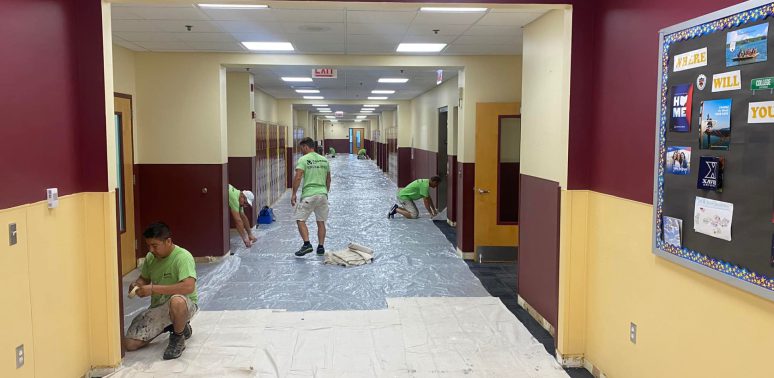
The following comparisons highlight how brush and spray techniques perform across key areas that matter most to commercial property managers, facility owners, and contractors.
Time & productivity: prep vs. application speed
Spray painting is significantly faster when it comes to applying paint, especially over large, open surfaces. A crew using airless sprayers can cover thousands of square feet in a fraction of the time it would take to brush or roll. This makes it ideal for warehouses, exteriors, or commercial ceilings where production speed is critical.
However, that speed comes with trade-offs. Spraying requires extensive prep time—masking windows, fixtures, flooring, and adjacent surfaces. If the space is occupied or full of interruptions, that prep may erase much of the time advantage.
Brush painting, by contrast, is slower in application but often quicker to set up. There’s minimal masking required, and painters can begin work quickly, especially in segmented or interior environments.
In situations where jobsite access is limited or operations can’t pause for full containment, brushing becomes the more practical option—even if labor takes longer.
Pretreatment & surface preparation requirements
Spray painting typically demands a higher level of surface preparation. Because it applies paint in a fine, even mist, any imperfections—dust, grease, rough patches, or peeling coatings—will show through the finish. That means surfaces often need to be washed, scraped, sanded, or primed before spraying can begin, especially on exterior or industrial jobs.
Brush painting is generally more forgiving. The manual pressure of the brush or roller can push paint into minor surface flaws, making it a good fit for aged or imperfect walls. For repainting older facilities or performing partial upgrades, brushing may reduce the need for extensive prep, saving time and labor.
That said, both methods benefit from a well-prepared surface. But when high-end aesthetics or warranty compliance is required, spraying often demands a stricter prep process.
Material & paint usage: coverage and waste
Spray painting uses more paint—often 20% to 50% more—due to overspray, bounce-back, and atomization loss. In windy outdoor conditions or on textured surfaces, this waste can increase even further. While sprayers offer fast, even coverage, they aren’t as efficient in terms of raw material use.
Brush and roller application, on the other hand, delivers paint directly to the surface with little waste. This makes it a more cost-effective choice when working with premium paints or in projects where material budgets are tight.
For commercial clients concerned about minimizing product use—whether for budgetary, environmental, or warranty reasons—brush painting may be the better option, especially on small to medium-sized projects.
Finish quality & aesthetics
When a clean, high-end finish is the goal, spray painting typically delivers superior results. The atomized spray produces a smooth, even coat with no visible brush strokes or roller texture. This level of uniformity is especially desirable in spaces like hotel lobbies, retail stores, or Class A office buildings where visual presentation matters.
Brush painting, while capable of delivering a neat finish, often leaves behind slight texture—especially when using rollers. Some clients may find the stippled effect acceptable or even desirable in certain settings, but it generally lacks the refined look that spraying achieves.
That said, in heavily textured or older surfaces, brush painting can hide flaws better. And in spaces with complex trim or decorative molding, a brush may still offer the best control to preserve crisp lines and edges.
Touch-ups, detail work, and blending
For detailed areas or future touch-up work, brush painting has a clear advantage. It’s easier to return weeks or months later and blend in a patch without obvious color variation or sheen mismatch. This is especially useful in tenant-occupied buildings, schools, or healthcare facilities where touch-ups are frequent.
Sprayed finishes, while smooth, can be challenging to repair seamlessly. Unless the same equipment and paint are used under similar conditions, touch-ups can stand out. This makes spray painting less flexible for ongoing maintenance projects or phased renovations.
In projects that require a high degree of access control or where surfaces may need minor adjustments after install (e.g., post-cabinet install touch-ups or hardware changes), brushing remains the more reliable option.
Health, safety & regulatory considerations
Today’s commercial painting projects increasingly prioritize occupant safety, environmental compliance, and low-disruption execution. Both brushing and spraying can meet these expectations—especially when low- or zero-VOC paints are used.
Spray painting, while efficient, still introduces atomized particles into the air during application. Even with safe coatings, fine paint mist can travel and settle on unintended surfaces or circulate through ventilation systems. As a result, spraying typically requires more containment measures, masking, and temporary area closures—especially in interior environments.
Brush and roller application, on the other hand, keeps paint localized and reduces airborne exposure. This makes it easier to perform work in occupied buildings or sensitive environments like schools, medical clinics, or retail spaces without full shutdowns or heavy isolation.
Ultimately, both methods can be safe when proper procedures and products are used—but brushing remains the preferred option when minimizing disruption and containment is a top concern.
Equipment, maintenance & cleanup
Spray painting requires specialized equipment—airless sprayers, hoses, tips, filters, and sometimes compressors. While this equipment allows for rapid application, it demands regular maintenance and thorough cleaning after each use. Clogged tips, worn gaskets, or unclean lines can lead to inconsistent spray patterns and delays on site. Crews must also be trained to use the equipment properly and troubleshoot on the fly.
Brush and roller painting involves simpler tools that are easier to manage and maintain. Brushes, rollers, trays, and extension poles require less setup and can be cleaned quickly at the end of the day. There’s also less risk of equipment malfunction disrupting the workflow. For jobs that span several phases or require flexibility, traditional tools offer greater ease of use and reliability.
While sprayers offer productivity advantages, they also introduce additional costs in equipment care, storage, and potential downtime—factors that need to be weighed for each project.
Operational disruption & masking strategy
One of the biggest concerns in commercial environments—especially in occupied or operational spaces—is how much a painting project will disrupt daily activities.
Spray painting requires more masking and containment to prevent overspray from reaching nearby surfaces, equipment, or occupants. This preparation can take significant time, and during spraying, access to the area often needs to be fully restricted. However, once spraying begins, the application itself is much faster than brushing—meaning the total time a space is out of use may still be shorter. For large areas or projects with tight deadlines, this speed can outweigh the longer prep.
Brush painting, on the other hand, involves minimal masking and allows for more localized work. Crews can paint in phases—one room or section at a time—without shutting down the entire area. This method is often preferred in settings like schools, offices, or healthcare facilities where continuous operation is critical.
Ultimately, spraying offers speed in execution but requires stricter isolation, while brushing offers flexibility with less disruption—making the right choice highly dependent on the project setting and schedule.
Cost comparison for commercial jobs
The overall cost of a commercial painting project depends on more than just the price of labor or paint. It’s a combination of time, material efficiency, equipment requirements, and how well the chosen method aligns with the building’s layout and operational needs.
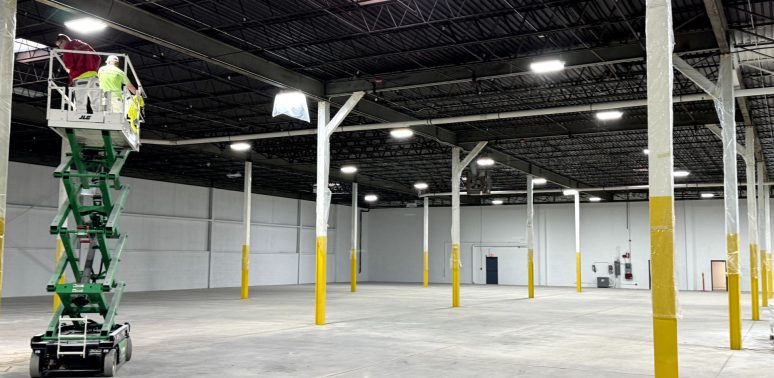
Spray painting can significantly reduce labor costs on large-scale projects. Its ability to quickly cover expansive surfaces—such as warehouse interiors, industrial ceilings, or exterior façades—translates into faster turnaround times and fewer total labor hours. This efficiency often makes spraying the preferred choice for high-volume jobs, especially when the building is unoccupied or access is unrestricted. However, spraying also brings added expenses.
Paint usage is typically higher due to overspray and atomization loss, and commercial sprayers require maintenance, cleaning, and, in some cases, rental or repair. Projects involving spray application may also involve more intensive masking and setup, adding to the overall labor bill.
Brush and roller application, though slower in execution, tends to use paint more efficiently and avoids the equipment-related costs associated with spraying. In smaller or segmented spaces—like offices, stairwells, or tenant improvements—brushing can be more cost-effective because it requires less preparation and can be done in phases without disrupting entire operations. It also eliminates the need for extensive containment or isolation, making it ideal for active commercial settings.
In many cases, the most economical solution comes down to choosing the right method for the job size and environment. While spraying offers labor savings in wide-open, unoccupied areas, brushing becomes more cost-effective in complex, detailed, or sensitive spaces where precision and flexibility matter most.
Which method is better? A detailed comparison table
| Brushing / Rolling | Spray Painting | |
|---|---|---|
| Application speed | Slower; labor-intensive, especially on large surfaces | Fast and efficient for large areas; reduces total project time |
| Setup & masking requirements | Minimal masking needed; quick setup | Extensive masking and prep; especially in occupied spaces |
| Surface preparation | More forgiving on imperfect surfaces; less prep required | Requires smoother, cleaner surfaces for best results |
| Finish quality | May leave brush or roller marks; acceptable for many interiors | Smooth, uniform, high-end finish with no texture |
| Paint usage | Minimal waste; efficient product use | Higher paint consumption due to overspray and atomization loss |
| Equipment needs | Basic tools; low cost and easy to maintain | Specialized sprayers; higher cost and regular maintenance required |
| Touch-up & maintenance | Easy to match and blend over time | Harder to touch up without visible differences |
| Operational disruption | Low impact; crews can work around active areas | Greater disruption; often requires isolating spaces or after-hours work |
| Cost efficiency | More cost-effective on small or segmented jobs | More cost-effective on large, open-surface projects |
When brushing makes more sense
Brushing or rolling is often the better choice for projects where control, precision, and minimal disruption are more important than speed. In commercial environments with active operations—such as offices, schools, medical clinics, or retail stores — brush application allows painters to work in smaller areas without extensive masking or isolation. It’s especially valuable in settings where crews need to work around staff, patients, or tenants with as little interference as possible.
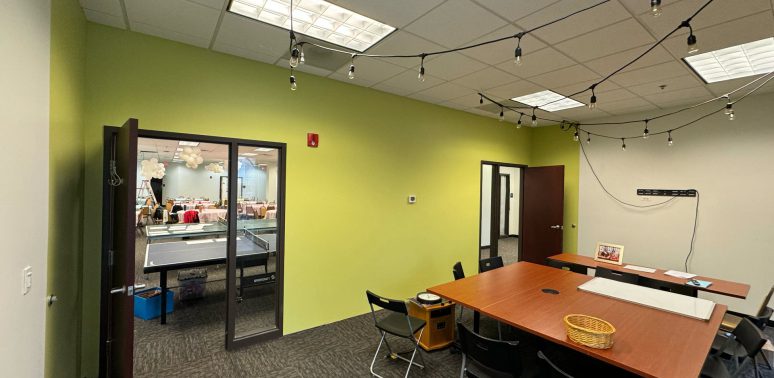
Brush painting is also ideal when detail matters. Trim, door frames, small rooms, stairwells, or irregular wall layouts require the precision that a brush or roller provides. Additionally, for projects involving repainting or ongoing maintenance, brushing makes touch-ups and blending far easier, ensuring consistent results over time.
In short, if your commercial painting job involves segmented spaces, sensitive environments, or high-detail areas, brushing offers the flexibility and control needed to get the job done efficiently and cleanly.
When spraying is the smarter choice
Spray painting is the clear winner when speed and surface area are the top priorities. For large-scale commercial projects—such as warehouses, industrial facilities, multi-story exteriors, or open-plan interiors—spraying dramatically cuts down on labor time while delivering a smooth, high-quality finish. If the building is unoccupied or scheduled for renovation, spraying enables crews to move quickly and meet tight deadlines without sacrificing appearance.
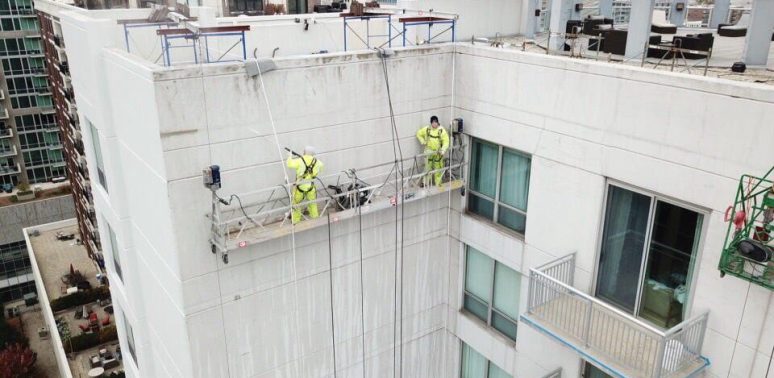
Spray application also excels on rough or textured surfaces, such as concrete, stucco, or metal siding, where a brush may struggle to provide even coverage. And in projects that require a flawless, uniform aesthetic—like retail showrooms, lobbies, or premium office interiors—spraying delivers a modern look that brushing can’t always replicate.
If your commercial painting project has broad surfaces, a compressed schedule, or a demand for premium finishes, spray painting is often the most efficient and cost-effective solution.
Hybrid approach: using both methods effectively
In many commercial projects, the best results come from using brushing and spraying together. This hybrid approach leverages the strengths of both methods—spraying for speed and broad coverage, and brushing for detail work and control.
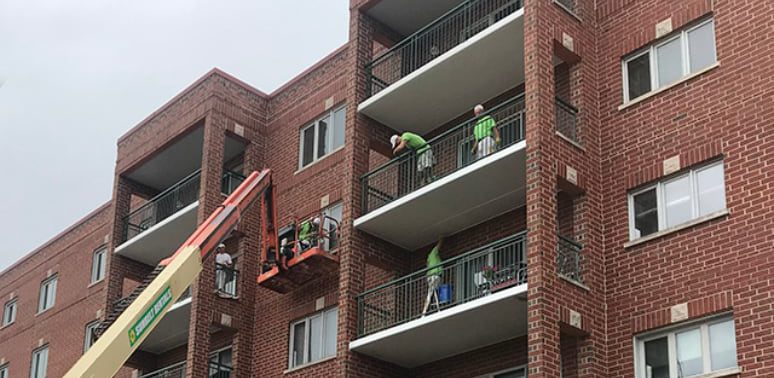
For example, painters might spray large warehouse walls or ceilings to save time, then switch to brushing for trim, corners, or high-traffic touchpoints. In office or school renovations, crews may spray common areas and brush tenant spaces where masking would be too invasive.
A hybrid method allows contractors to adapt to the unique needs of each space, delivering both efficiency and attention to detail. It also enables phased work and simplifies touch-ups after furniture installation, inspections, or follow-up repairs.
By planning ahead and knowing when to switch between methods, commercial painting teams can maximize productivity without compromising quality.
Which technique is right for your business?
The best painting method for your commercial property depends on your specific priorities—timeline, finish quality, project size, and whether the space is occupied. Spray painting delivers unmatched speed and smoothness for large or time-sensitive jobs, while brushing offers greater control, lower disruption, and easier maintenance in detailed or active environments.
For many commercial projects, a combination of both methods provides the best outcome. By evaluating your building’s layout, operational requirements, and long-term goals, you can choose the approach—or combination—that ensures efficiency, durability, and a professional result.
If you’re unsure which direction to take, consult with a professional commercial painting contractor who can assess your space, recommend the right method, and tailor the work to meet your needs.
Best painting method for commercial interiors
Interior commercial spaces often have tighter access, active occupants, and more detailed features, which makes the choice of painting method particularly important. In many cases, brush and roller application becomes the go-to technique due to its precision, lower disruption, and ease of control in segmented environments.
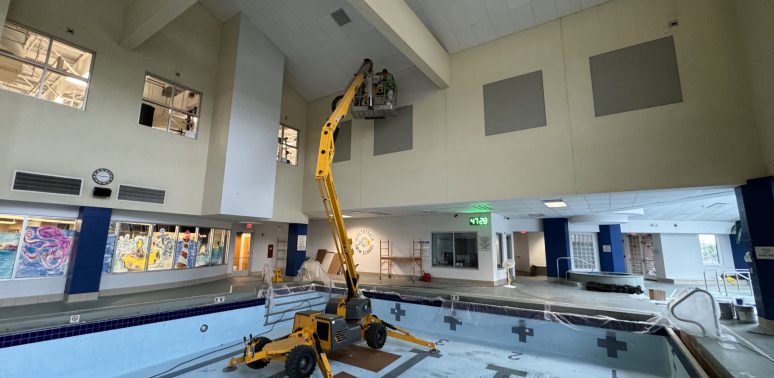
Brushing allows painters to work in occupied offices, classrooms, medical facilities, or retail stores without the need for full isolation or shutdowns. Crews can paint in phases—one room, hallway, or section at a time—while keeping most of the building operational. The minimal overspray risk means less masking and fewer concerns about paint settling on furniture, electronics, or merchandise.
Furthermore, many interior jobs involve architectural details—window trim, door frames, baseboards, recessed lighting, or accent walls—that benefit from the control of a brush or roller. This method also enables easier blending and touch-ups over time, which is particularly valuable in high-traffic areas where repainting may be phased or repeated annually.
That said, spray painting can still be effective in unoccupied interiors or open layouts where masking is manageable. For example, large commercial renovations or new construction interiors often benefit from spray techniques to expedite timelines and achieve a high-end, uniform finish across ceilings, open walls, and exposed ductwork.
Ultimately, when the goal is to minimize disruption, preserve indoor air quality, and maintain fine control, brushing or a hybrid method is usually the better fit for commercial interior work.
Best painting method for commercial exteriors
Exterior commercial painting projects typically require speed, weather resistance, and consistent results across large surface areas—making spray painting the preferred method in many cases.
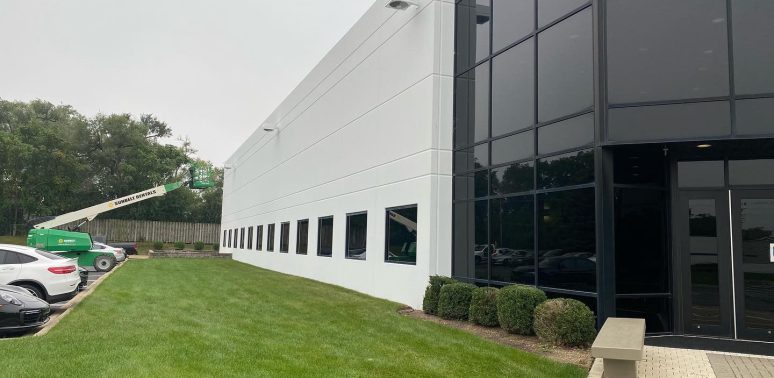
Airless spraying is ideal for applying paint to building façades, metal cladding, concrete panels, stucco, or brick. These surfaces often have texture or irregularities that a sprayer can cover quickly and evenly, reaching into grooves and filling imperfections without extra pressure or effort. In warehouses, retail centers, manufacturing buildings, or multi-story properties, spray painting dramatically cuts down on labor hours while producing a clean, modern finish.
The efficiency of spraying is particularly valuable when weather windows are limited. A crew using sprayers can finish the job in days instead of weeks, reducing the risk of delays caused by rain, wind, or temperature shifts.
However, brushing and rolling may still be necessary for trim, signage, railing systems, entry points, or hard-to-reach architectural features. In some older commercial buildings, brushing may also be preferred to preserve surface integrity or maintain a hand-finished look.
Exterior jobs do demand more extensive masking and containment—especially to protect landscaping, signage, parked vehicles, or pedestrian areas from overspray. In busy urban or storefront settings, nighttime spraying or off-hours work may be required to limit disruption and comply with local regulations.
In short, for large exterior surfaces with minimal interruptions, spraying is usually the smartest and most cost-effective solution. But successful commercial exterior painting often requires a combination of both methods to address detail work and ensure full coverage without sacrificing quality or safety.
Choose commercial painting experts who use the right method for the job
Whether your project calls for precision brushwork, efficient spray application, or a smart combination of both, our team has the experience and equipment to deliver flawless results. We understand the unique demands of commercial environments—tight timelines, active facilities, and high-quality expectations—and we tailor our methods to fit your space and schedule.
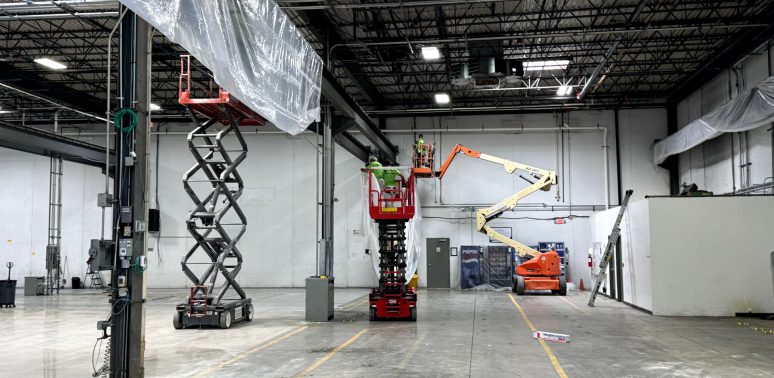
From office interiors and retail spaces to warehouses and industrial exteriors, we approach every job with careful planning and attention to detail. Our use of low-VOC paints and professional-grade tools ensures safety, durability, and minimal disruption to your operations.
Ready to get started? Contact us today to schedule a consultation and discover the most effective painting solution for your commercial property.
Frequently asked questions about commercial painting methods
When planning a commercial painting project, it’s natural to have questions about the best application methods, costs, timelines, and outcomes. Whether you’re managing a high-traffic interior space or coordinating an exterior repaint, understanding how brush and spray painting differ—and when to use each—is key to a successful project.
Below are some of the most common questions we hear from property managers, facility directors, and business owners when deciding how to approach their painting needs.
Is spray painting always faster than brush or roller application?
In terms of pure application speed, yes—spray painting covers large surfaces significantly faster than brushing or rolling. However, this speed comes with more setup and masking time, especially in occupied buildings. The total project time depends on the space, surface prep needs, and masking requirements.
Does spray painting use more paint than brushing?
Yes. Spray painting typically uses 20–50% more paint due to overspray and atomization loss. It’s faster but less efficient with materials. Brushing and rolling deliver paint directly to the surface, which minimizes waste—especially on small or detailed jobs.
Which method gives a better-looking finish?
Spray painting produces a smooth, uniform finish with no visible brush or roller marks—ideal for modern interiors or client-facing areas. Brushing may leave some texture but offers better coverage in hard-to-reach or detailed spots. Each method has its place depending on desired aesthetics and surface conditions.
Can you spray paint inside an occupied building?
It’s possible, but it depends on the conditions. Interior spray painting requires careful containment, masking, ventilation, and often after-hours scheduling. In sensitive environments (like clinics, offices, or schools), brushing is typically safer and less disruptive.
Which method is better for touch-ups and maintenance?
Brushing and rolling are much easier for spot repairs. You can match texture and color more seamlessly, even months later. Spray finishes can be harder to replicate without the same equipment and conditions, making touch-ups more visible.
How do I know which method is right for my building?
That depends on your project goals—timeline, occupancy status, surface types, and visual standards. Spray painting is great for large, open areas or new construction. Brushing is better for segmented spaces, detail work, or when disruption must be minimal. A hybrid method is often the smartest solution.
Are there safety differences between spraying and brushing?
Yes. Spray painting requires more protective gear, ventilation, and isolation due to airborne particles. With modern low-VOC paints, both methods can be safe—but brushing typically involves fewer safety concerns and less impact on indoor air quality.
Will using a sprayer save me money on a commercial job?
It depends on the scale. For large, unoccupied spaces, spraying can reduce labor costs despite higher material use. In smaller, detailed, or active areas, brushing may be more cost-effective because it avoids the need for extensive masking and containment.